
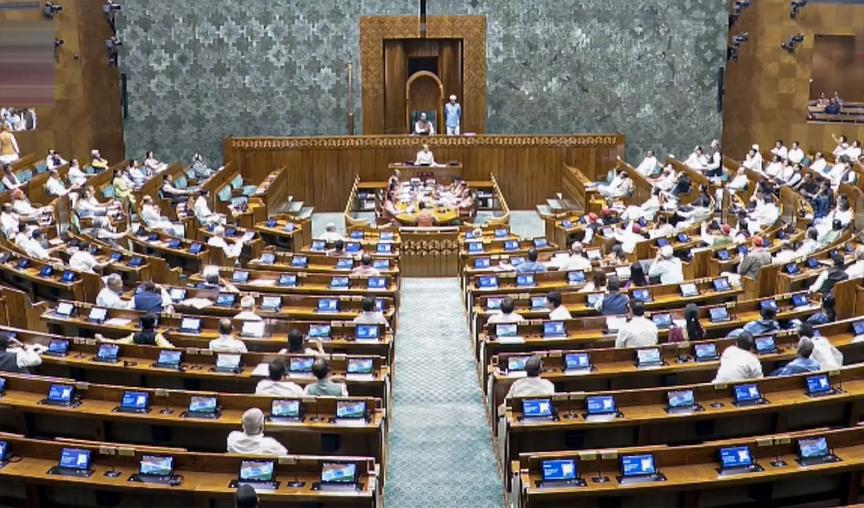
The Narendra Modi government has asked the Lok Sabha Speaker to reconvene the Lower House on November 30 and the Rajya Sabha Chairman to reconvene the Upper House on December 2 “to transact essential Government Business”. The sittings are expected to be part of Parliament’s Monsoon Session.
Union Parliamentary Affairs Minister Kiren Rijiju said on Thursday that sittings in both Houses could conclude on December 3, depending on the business before them. He did not specify which Bills would be taken up.
The announcement comes amid speculation that the government could revive legislation on delimitation and women’s reservation. Both Houses were adjourned on August 13 without being formally closed.
By November 21, the Monsoon Session had remained formally open for 100 days after the adjournment, surpassing the previous record of 87 days set in 2008.
WOMEN’S QUOTA, DELIMITATION BILLS FAILED IN APRIL
The Lok Sabha rejected a constitutional amendment Bill on April 17 that sought to fast-track women’s reservation by allowing delimitation without waiting for a fresh Census.
The vote took place during a special three-day sitting of Parliament from April 16 to 18.
Of the 528 members who voted, 298 backed the Bill and 230 opposed it. The Bill fell 54 votes short of the 352 needed for a two-thirds majority.
After the vote, Rijiju urged Lok Sabha Speaker Om Birla to hold off on taking up two related Bills, the Delimitation Bill, 2026 and the Union Territories Laws (Amendment) Bill, 2026.
THE BUZZ AROUND BOTH CONSTITUTIONAL BILLS
The Women’s Reservation Act provides for 33 per cent reservation for women in the Lok Sabha and state assemblies. The quota will take effect after constituencies are redrawn in a delimitation exercise based on a fresh Census.
The April Bill sought to allow delimitation to go ahead sooner so the quota could be implemented before the 2029 Lok Sabha election.
The Bill also proposed increasing the Lok Sabha’s strength from 543 seats to a maximum of 850. Southern states have raised concerns that they could end up with a smaller share of seats in an expanded House.
The government is understood to be considering a 50 per cent increase in Lok Sabha seats for every state. Another option is to retain each state’s existing share of seats in the expanded House. The current allocation is based on the 1971 Census. No final decision has been taken.