
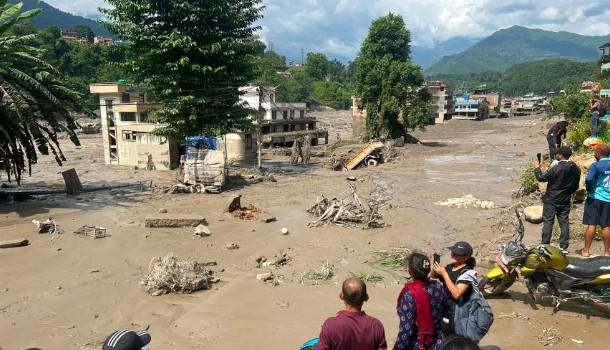
The catastrophic flash floods in Nepal have claimed the lives of 469 till now, said the police on Friday morning, as authorities have stepped up their efforts for a relief and rescue operation. However, they fear the death count may rise further as more than 1,400 people, including hundreds of foreign nationals, still remain missing.
As per Nepal's authorities, foreign nationals from over 30 countries are missing since Wednesday's tragedy. Of them, 288 are Indians, including 73 people who were working on a power project, and New Delhi is coordinating with Kathmandu is tracing the missing persons and helping the Himalayan nation in the rescue operation, as per the data provided by the Ministry of External Affairs (MEA).
3 killed in China
While the flash floods claimed 469 lives in Nepal, Chinese state media has confirmed that three people had also died in Tibet. It has also said that 499 local residents and 555 tourists have also been evacuated from disaster zone, as the situation continues to remain grim.
Chinese state media has also said authorities have warned of high flood risk from a lake that was formed following the mudslide on Wednesday. It has said a heavy rain forecast was issued for next three days, forcing authorities to issue a warning over a "high risk of breaching and sending floodwaters downstream" from the lake.
"According to forecasts, inflows into the lake could reach about 3 million cubic metres over the next three days amid continued rainfall, increasing the risk of a breach that could send floodwaters downstream and potentially cause further damage in areas including Gyirong Port and elsewhere downstream", state news agency Xinhua reported late Thursday.
Experts analyse satellite imagery
While rescuers are searching for survivors, scientists and experts have begun analysing the satellite imagery to find what led to the apocalyptic event on Wednesday. Earlier, it was claimed that an earthquake was responsible for the incident, but the United States Geological Survey (USGS) later clarified that a glacial collapse caused the flash floods.
Analysts also believe that global warming could be responsible for the flash floods, even as they continue contemplating the causes. Many suggest that climate change could not be directly linked to the crisis, though, and a thorough research is needed.
"All the indicators, to me, point to the impacts of warming trends... In this case, the permafrost that for millennia has helped to hold together high-altitude rock and ice and soil and glaciers is now weakening and becoming unstable," Associated Press (AP) quoted mountain geographer Alton Byers as saying.