
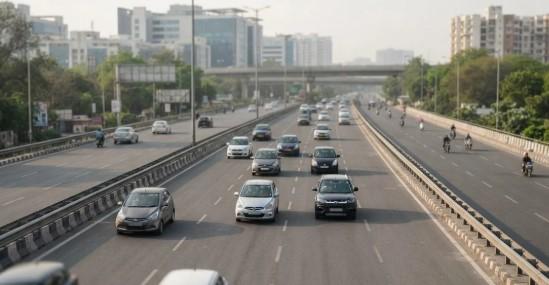
The government has notified new Corporate Average Fuel Economy (CAFE-3) norms that will set fuel-efficiency and carbon-emission limits for passenger vehicles from April 1, 2027, to March 31, 2032.The new norms broadly cover passenger cars, including hatchbacks, sedans, special utility vehicles, and MPVs, with a seating capacity of eight passengers other than the driver.
The new norms will apply to new passenger vehicles manufactured or imported for sale in India, the power ministry said in a statement.
The new norms will provide more choice for consumers in terms of technology, while car manufacturers will have to plan their production accordingly.
In a major shift, the draft CAFE-3 regulations had initially proposed a concession for lightweight petrol cars (under 909 kg) to keep them affordable, the final norms eliminated this benefit.
Under the new norms, the revised target line has also been flattened to provide a more balanced, weight-sensitive approach, with relatively softer targets for lighter vehicles and greater fuel-efficiency requirements for heavier vehicles.The reference weight has been increased from 1,082 kg under existing norms to 1,229 kg under new CAFE norms, an increase of around 13.6 per cent, reflecting the evolving characteristics of the passenger vehicle fleet.The new norms provide flexibility to manufacturers to adopt cleaner technologies, alternative fuels and other innovative solutions.To encourage cleaner transportation, the new regulations offer "super credits" for Battery Electric Vehicles (BEVs), Range-Extended Electric Vehicles (REEVs), Plug-in Hybrid Electric Vehicles (PHEVs), Strong Hybrid Electric Vehicles (SHEVs) and flex-fuel vehicles, making it easier for manufacturers to meet fleet emissions targets when producing alternative-fuel models.
Under the updated regulations, alternative fuels, EVs, and hybrids will benefit from volume derogation multipliers, commonly referred to as "super credits," when calculating total fleet-average emissions.
"This provides an additional incentive for manufacturers to accelerate the deployment and market penetration of cleaner and advanced vehicle technologies," the statement said.
Additionally, the fuel-consumption benchmark is tightened from 3.996 litres/100 km in 2027–28 to 3.3273 litres/100 km in 2031–32, representing an improvement of around 16.7 per cent over the period.
The new CAFE framework will drive progressive improvements in fuel economy through year-on-year tightening of targets across all five years.
The new CAFE framework promotes technological innovation in new technologies such as solar reflective paints, advance glazing, high efficiency air-conditioning for improved fuel efficiency and India's energy security and sustainability objectives, the statement added.
The CAFE-3 norms also introduced a credit-debit system. The framework gives manufacturers added flexibility to meet CAFE targets. Companies exceeding their targets earn credits that can be carried forward.
Conversely, those falling short can make up the deficit using past credits, trading credits with other automakers, or purchasing them through a Bureau of Energy Efficiency-administered buyout program, the statement added.
The passenger vehicle segment accounts for a substantial share of India's transport energy demand and remains an important contributor to fossil-fuel consumption.
The new CAFE framework is consistent with and supports rapid technological advancements, increasing availability of alternative and renewable fuels, growing electrification and evolving global automotive technologies.